
Nobody changes video platforms for fun
It touches every upload, every integration and every viewer. Teams move when something has broken badly enough that the migration is the smaller problem — so this page is about the four things that usually break.
One account, six connected services
No separate contract for playback, encoding, live, storage, delivery, or protection — it’s the same account, the same API, and the same bill for all six.
 Video Player
 Transcoding
 Live Streaming
 Media Storage
 Content Delivery
 DRM
DRMReason 01 · Consolidation
Video is never sold to you as one thing
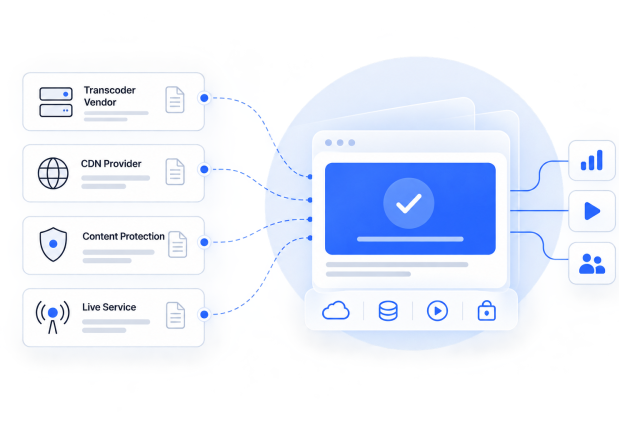
It arrives as four purchases. A transcoder here, a CDN there, content protection bolted on from a third vendor, and a separate service for anything live.
Each one is defensible on its own. Together they are four contracts, four dashboards, four invoices, and four support queues to work out whose fault an outage was.
Every boundary between vendors is a place a job can be accepted by one and lost by the next, with no single log to read.
What we do instead
One account covers transcoding, live streaming, storage, delivery, playback and DRM. One API key, one bill, and one place to look when something is wrong.
Reason 02 · Protection
Content protection priced as an upsell
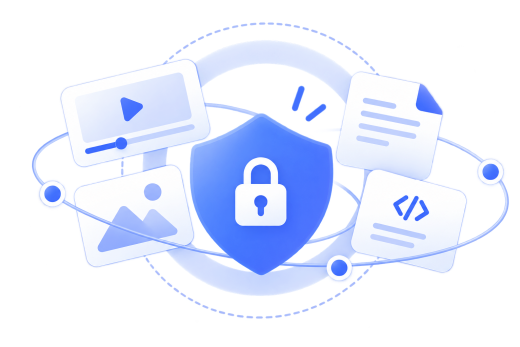
DRM tends to live behind the enterprise tier, or arrive as parts you are expected to assemble yourself — which means the plans most teams actually buy ship without it.
A signed link without DRM is obscurity, not protection. It holds until one person opens developer tools.
Widevine, FairPlay and PlayReady are three separate integrations if you go and buy them separately.
What we do instead
All three DRM systems, per-stream licence tokens, and domain and device restrictions are on every paid plan — including the $150 entry tier, which comes with 55,000 licences.
Reason 03 · Feedback
Finding out by refreshing
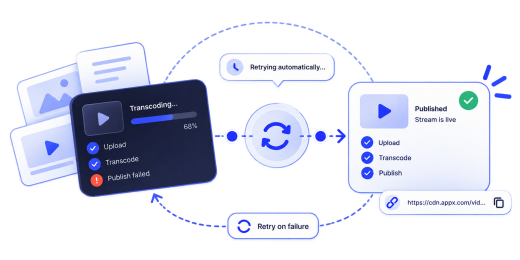
A transcode finishes when it finishes. With no events to subscribe to, the only way to know is to ask again — a polling loop that burns calls, adds latency to every publish, and still cannot tell you why a job failed.
Each delivery carries a signature and a delivery id that retries reuse, so handling one twice is safe by construction.
What we do instead
Register a URL and we post to it the moment a video completes, a stream goes live, or a job fails — signed with a shared secret, with every event and payload published in the reference.
Reason 04 · Pricing
Ask sales what it costs
Quoted-only pricing turns an evaluation into a negotiation before anyone has written a line of code. You cannot compare what you cannot see, and the tier above the one you are buying is the one you actually have to plan for.
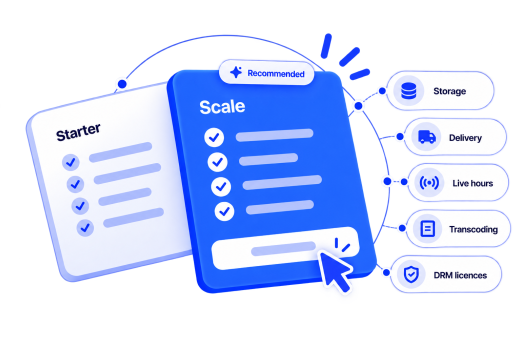
Storage, delivery, live hours, transcoding and DRM licences — the five numbers that decide the bill — are published for every plan.
What we do instead
Every price and allowance is on the pricing page, the tier above yours included. Scale is the only plan we ask to put in writing, because it carries an SLA.
Migration
What switching actually involves
The fear is a cutover weekend with a catalogue stuck half-moved. It does not have to work that way — new and old run side by side for as long as you need them to.
- Day onePoint new uploads hereEverything recorded from today lands on StreamOS. The existing catalogue keeps playing exactly where it already lives.
- In the backgroundBackfill at your own paceMove the old library when it suits you, in whatever order matters. Both platforms serve traffic at the same time for as long as you need.
- When you are readyCancel the old contractsOnce playback and delivery are confirmed here, the vendors you no longer need come off the bill. Not before.

Point one upload at us and judge it from there
Nothing has to move on day one. Start with the next video you record and keep the rest exactly where it is.